Tuned Up and About to Charge the Battery – the Pain Clinic

So I made it to the pain clinic in one piece – just!  The body work did its utmost to stop me and it was probably the furthest that I have travelled in my motability chariot (in time – it was rush hour travelling into London, you understand!) – so our arrival at St Thomas’ was surrounded by a cacophony of feelings in back, hips and thighs, with the right hip spluttering the loudest.

Fortunately parking is never an issue because the carpark is so blooming expensive – but, any blue badge pals out there – did you know that at St Thomas’ you are able to park for free if you show your appointment letter and you actual blue badge to PALS.  At Guys you can also park for free in the NCP carpark along the road by presenting your letter, NCP ticket and blue badge to security before you leave.  Might have saved someone a small fortune there!  What was an issue was getting into a lift from the basement to the ground floor – I mean, come on people, I am not sitting a wheelchair because I am feeling a bit tired.  I can’t actually climb the stairs!!

Tuned Up

The engine revived with caffeine and banana, we checked in to the pain clinic which faces directly opposite Big Ben and the Houses of Parliament – currently shrouded in scaffold.  I always forget just what a wind tunnel is created along this stretch of the Thames and Wednesday morning was no exception – good job I was using my wheels because the icy gusts would have tackled me easily.  As predicted the CNS was surprised and concerned when she saw me, but once I reassured her that the bodywork changes before her are down to the dreaded stretchy body parts, she went about checking the pain levels.  I am pleased to report that once her little box of tricks “spoke” to my implanted little box of “tricks”, it was established that my switching on and off, general usage of the stimulator and recharging is all scoring full marks! Hurray.

Next the tricky part.  Any chance of a retune?  This was no problem and the external box turned off and then turned back on the internal box…..jump starting the battery back to life and automatically altering the sensation.  The biggest difference is the feeling in the sole of my foot – it is difficult to describe, but the electrical pulses feel more rapid and “wider”.  The pathway of the pain through my foot is so specific that I could draw it for you to see, so the area that needs to be covered by the neurostimulation is very specific and so very specific electrodes in the lead on the spinal cord need to be active.  But how about getting some of that lovely electrical stimulation that knocks out the way my dodgy wiring sends perceived pain to my nerve centre – my brain – into my right hip and thigh??

Of course the proper response is that nothing can be altered for pains that haven’t been investigated – it wouldn’t be good to mask pain that is due to injury or a new illness.  But of course in this case one bendy chassis is causing wear and tear on the bearings and axles, putting the tracking off massively.  The biggest concern had to be keeping the pain coverage in my right side to the same level – it would be awful to lose the fantastic coverage i have.  But with a little tweaking she managed to give me a little sensation in my hip and if I lean back into the chair (or better still lie down onto the electrodes) the strength of the stimulation increases.  It doesn’t get rid of the pain or even mask it in the same way that it masks the nerve pain, but any little bit of relief this rust bucket will take!

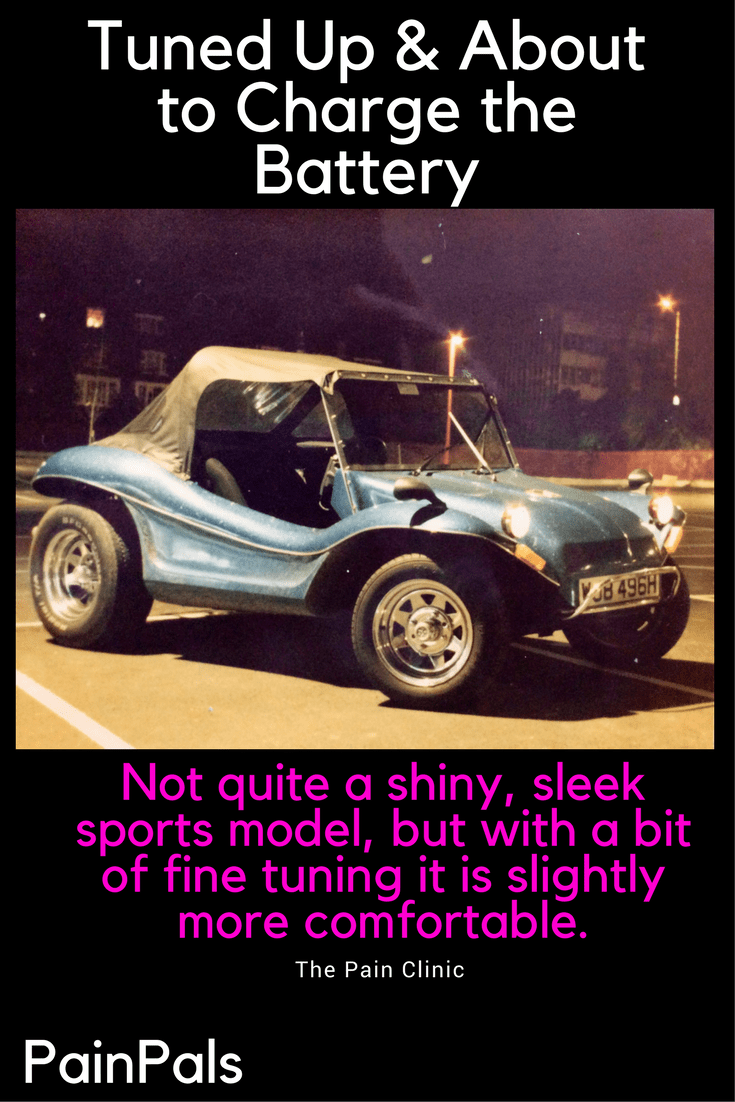
So the bodywork may not have been replaced by a shiny, sleek sports model, but with a bit of fine tuning it is slightly more comfortable.  (BTW the beach buggy above was Dunc’s first car, and whilst sparkly, not very comfortable!). Thanks for all the good wishes – really appreciated.  Now I’m off to recharge my battery for a new week…..and in this case I assure you I am being literal, not metaphorical.  Should take me a couple of hours to complete!IMG_0817

(BTW: any St Thomas’ pain/input patients out there – the booking system was changed last year and the nurses are no longer allowed to book our appointments.  But since central bookings has taken over, quite a few of us have slipped through the net – hence why I had no appointment last year.  If you have a problem call them or email the nurses at their catchy new address:

IMG_1411

What are Dysautonomia and POTS?

Hannah on Sunshine and Spoons blog has written this post about Dysautonomia and POTS (postural orthostatic tachycardia syndrome).

She recently did a straw poll on a facebook group that we belong to and very few people had any idea what this medical term means.  I knew because I have it…..but had never come across the term in my own medical career.  Some of you will have read how my symptoms have been particularly bad recently, but I am now able to stand upright again!!

Please read the whole piece and share in order to help us spread awareness!

What are Dysautonomia and POTS?

What are Dysautonomia and POTS-

Did you know that October is Dysautonomia Awareness Month?

Let me back that up a little….do you know what dysautonomia is?

If you said no, you’re not alone.  Most people have never even heard of it.  I didn’t know what it was either until I was diagnosed with it.  I have Postural Orthostatic Tachycardia Syndrome or POTS which is one of the autonomic disorders that falls under the umbrella term of dysautonomia.  Other types include Neurocardiogenic Syncope or NCS and Multiple System Atrophy or MSA.

Despite the fact that many people have never heard of dysautonomia, it’s not rare.  It’s estimated that over 70 million people around the world have it in one form or another.  Often, it’s a secondary condition to another disease or disorder such as diabetes, Ehlers Danlos Syndrome, Multiple Sclerosis, Lupus, Celiac Disease, arthritis, and more   The most severe cases can result in death.

What is POTS?
Your autonomic nervous system regulates different functions throughout your body such as your heart, digestion, temperature, blood pressure, etc.  People with an autonomic disorder such as POTS have issues regulating those things.


To read the whole post visit Sunshine and Spoons 

You will also find great links to Hannah’s Sunshine and Spoons Shop

POTSWarrior5


The Masseuse who pulled my Arm Out

Many of us bendies will relate to this! In fact the same thing happened to me – just replace the word masseuse with anaesthetist and the salon with operating theatre.  You get the idea!


Life with a disability can sometimes give rise to unspoken questions and sensitivities, but amid the awkwardness there can be humour. The following is an edited version of a sketch by Angela Clarke who has Ehlers-Danlos syndrome, delivered for the BBC at the Edinburgh Fringe Festival.

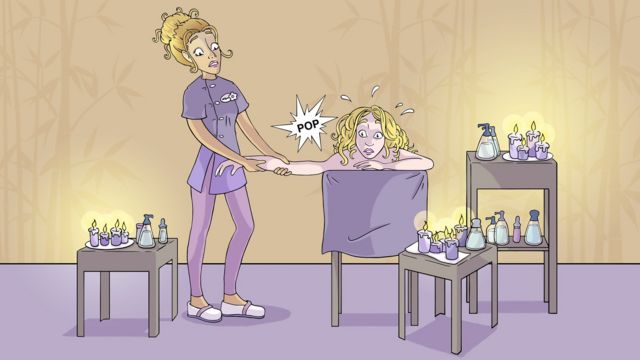
Illustration of Angela Clarke's arm dislocating due to Ehlers-Danlos syndrome
Image by Sarah Dousse, BBC.COM

I was away at a fancy spa and thought I’d indulge in a nice relaxing massage as a treat.

The softly spoken therapist, who was called something ethereal and calming like Summer or Melody or Zinfandel Blush, told me she would be using an aromatherapy oil of lavender picked by organically trained squirrels and mermaid tears.

The room was painted in calming shades of rice pudding, scented candles flickered around me and music, which sounded like whales fornicating, played in the background.

I was so preoccupied with getting onto the high massage table that I forgot to mention a vital piece of information – I have an invisible disability. Big mistake.

I have Ehlers-Danlos syndrome (EDS), a debilitating condition which affects connective tissue like skin and tendons and, among other things, means I injure easily.

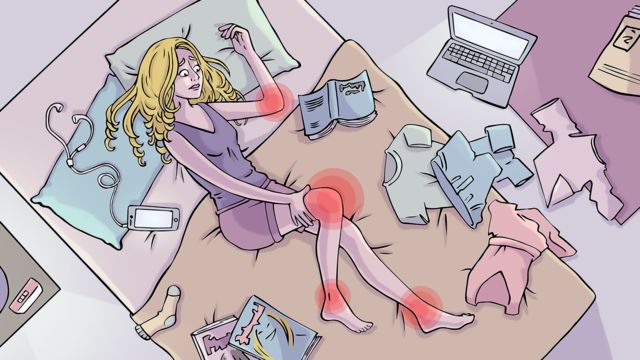
It’s genetic. I got it from my mum. Worst birthday present ever. While some people with EDS have no complications, other than being super-flexible, I get chronic pain, frequent dislocations, and mobility issues. Mum, on the other hand, got straight into advanced yoga…….

………

_97416017_angela'sstory3
Image by Sarah Dousse, BBC.COM

So there I am, blissed out on the massage table. Zinfandel Blush has marinated me like a chicken breast. The whales are climaxing in the background, and I’m drifting off to sleep.

She runs her oil-covered hands down my arm and gives it a gentle tug to stretch out my stiff shoulder, but it just keeps coming, until pop! It comes clean out of the socket. Dislocated.

Believe me, it gets funnier! For the complete, hilarious post go here – BBC Ouch!

Chronic pain, opiates…& where does that leave me? (Part 2)

continuing from yesterday’s republished post, this is the follow up written at the time with a few additions and adjustments for today…..

So where does this leave me?  I am the person sitting in that seat desperately in need of help.  This “me” refers to all of us experiencing chronic pain whatever the reason – pain that has lasted for longer than 12 weeks – 6 months depending upon who you read!

From that first visit to our general practitioner to the physio to the surgeon, it can feel like everyone is giving conflicting advice.  I don’t blame the GPs for starting so many of us on opiates.  When the gabapentin or lyrica isn’t sufficient, and the amitryptilline doesn’t touch the sides, there isn’t much else left to turn to when this desperate individual is begging for help. images (20) In the same way, how many of us have surgery out of desperation?  I am sure that the neurosurgeon who performed my first fusion really didn’t know what else to do with this weeping woman on his consulting room floor, declaring she couldn’t take any more!  I don’t think that anyone takes these drugs lightly as the side effects can be so debilitating and vary from person to person.  The consultant from my last job prescribed my first cocktail and I never dreamt that I would be taking them for so long or quite how they would affect me.
We’re prescribed tramadol, sevredol, oromorph, MST, oxynorm/contin, and at first there is usually some relief.  For me the drugs never completely masked the pain and the dose of pregabalin was soon topping the scale and the oxynorm started creeping upwards soon to be replaced with the long acting variety.  I smile now when I think how at work the “control” drugs are kept in double locked cupboards and yet my bottle of oxynorm was stuck on the kitchen window sill to take a quick swig when the pain became too much.  My GP never tried to limit amounts and gradually increased the dose over the years.  I had also been prescribed mirtazepine to take at night – another antidepressant drug prescribed by my old consultant.  The side effects were horrendous.  I tossed and turned all night yet was unable to function the next morning to the extent that I knew the kids were in the room, but I couldn’t open my eyes.  Eventually I weaned myself off. But at my very first appointment at St Thomas’ Dr P took one look at my meds and informed me that the opiates would have to be reduced.  Yes, he did explain why with the reasons from part 1, but I think that everything that came after was a blank.  There is a feeling of panic – how on earth will I cope with less than I am taking?  This isn’t even working!  A fear deep in the pit of your stomach as the realisation that you may be forced to try to tolerate higher levels of pain hits home.images (21)

St Thomas’ hospital, London, policy for patients on the spinal cord stimulator programme is that you should not be taking any liquid or injectables; breakthrough doses should be weaned right down before the trial; and high doses of long acting opiates should be weaned down (MST & oxycontin).  I don’t know why different hospitals have different policies.  In my experience over the years consultant preference has always played a huge role in this type of policy.  I have no idea how other countries deal with this issue, but I do know that the USA carry out a huge number of  nerve transmitter inplants each year.  We all have different pain and maybe a one policy fits all is not the right way to go.  Within our group a lady barrister had a chronic bladder problem (interstitial cystitis – for further information have a look at this great blog: Bladder Help) which left her with constant raw areas on the bladder wall.  Her pain had very specific flares resulting in a trip to A&E approx monthly and pethidine injections until the flare subsides.  She was unable to imagine how she could possibly cope during these times of crises.  For further information on bladder related problems visit Layla’s http://bladder-help.com/

Telling us that we must cut back is the easy part. Doing it is somewhat trickier.  There will be several people on SCS facebook support groups at any one time who are currently struggling as the pain spirals up as the drugs go down.  It is tough on nearest and dearest too.  Every time that I have lost the plot in recent weeks, my daughter looks knowingly at the rest of the family and mouths “drugs” – even when she deserves to be yelled at!  So is there a simple answer?  I guess the obvious would be not to prescribe opiates in the first place, but until a suitable alternative becomes available, I don’t believe this will happen any time soon.  So meanwhile, we dependents will have to ask you friends, carers and medics to bare with us as we attempt to wean down our dosage, to offer love, support and most importantly, please don’t judge when the going gets tough, as it certainly will.

Update 2017:  I was still taking oxycontin when I had my scs trial and the permanent implant, although I had managed to reduce the dose.  Over the following months, with huge support from my GP, I continued the process of weaning down my dosage – afterall one of the reasons for having the implant was to be free of drugs.  Bloody mindedness stepped in and I came down the doses considerably quicker than my GP wanted me to, but be under no illusion, it was not easy.  Upset stomach and cramps (for someone with EDS gut issues normally), sweating (additional to POTS symptoms), concentrations issues, insomnia (worse than previously) and more.  I met up with several friends I mad on the pain course last summer, and whilst we had all had different experiences with the scs, we were all agreed that we felt better since ceasing opiates.  We still have chronic pain.  But we have found that we have better nights (remember I can’t have my scs switched on at night so have no relief for my nerve pain) – not necessarily sleeping more, but better quality sleep – and the feeling of being oneself again.

For me a noticeable difference has been an increase in the pain associated with my Ehlers Danlos syndrome in my joints and soft tissues since stopping the oxycontin.  I believe that the opiate was masking my deteriorating condition and I am now having to learn to manage this without resorting to strong opiates again.  On bad days it would be very easy to open those bottles of oxynorm again!  download (1)Funnily enough I actually find that weak opiate based drugs, such as codeine phosphate/paracetamol mixes, give me more side effects causing me to reach for alternatives first (heat, gentle movements, gels etc etc). On the bad days……! The spinal cord stimulator has definitely given me control over the chronic pain in my back and leg caused by nerve root damage – I can go as far as to say that I would be unable to manage life without it.  But I am not drug free – I remain on the highest dose of pregablin/lyrica – and it currently is unable to provide any relief for my other chronic pain.
I plan to cover some of the more recent innovations in neuromodulation and also pregabalin?Lyrica – please send me your thoughts or suggestions!


Monday Magic – Inspiring Blogs for You!

Another week, another Monday – so that means one thing here at PainPals!  Thank you so much for the feedback for this feature – I love to hear if you are enjoying it, but please do send other comments and suggestions for anything you would like to see!

Monday Magic

There have been two major events in our house over the last week.  The first was a long awaited appointment with a geneticist for the beautiful girl(BG).  I can’t remember if I have mentioned before that we were struggling to find a consultant of any specialism who would accept the kids – just for a consultation.  Unfortunately University College Hospital London Hypermobility/EDS unit no longer take referrals straight from a GP but instead it needs to be from another hospital – this has changed since my own diagnosis.  My GP tried 2 rheumatologists – one recommended by UCLH – and both turned the requests down as the A level student (soon to be known as the politics student – we hope!!) and the BG were then under 18.  So..we tried a local paediatrician and by the time the referral was churned out through the system, said A level student had turned 18!  Then the children’s department decided that they really weren’t the right people to see the BG.  Finally a fantastic lady in the hospital bookings found a genetics consultant from a London hospital who runs a satellite clinic monthly in our local hospital – and even better she specialises in children! Hurray.

Meanwhile the BG has become convinced that she is just making a fuss and doesn’t really need to have a confirmation of symptoms – her biggest concern was that using the Beighton scale she doesn’t have a high hypermobility rating.  Hmmm…..mother here keeps explaining, as her shoulder clunks out of joint for the umpteenth time and she can hardly walk due to hip and knee pain, that there are so many other elements to consider here, particularly a very strong generational family history.  The consultant was a lovely lady who listened to me, my history, the family history, the issues my boys have had and then to the BG herself.  No she isn’t the most hypermobile person she has ever seen, but can she can already see that the BG has hips that are out of alignment and the dislocations are causing the same with her shoulders, so this immediately puts her back at risk of scoliosis and future problems.  Ringing bells in my ears!!!  More of this in another post…..

The second major event was our old dog Sam having a massive haircut with our fantastic groomer.  Now I don’t wish to play down the wonderful care given to my girl, but Sam is about 15 (rescue dog so not entirely sure) and like his human mum, has a very dodgy lower back,  hips and rear legs.  He has YuMove pills daily and struggles to walk now, so getting into the doggy bath and being strapped in the harness before the Jacuzzi begins is no mean feat for an old boy!  He came home a couple of hours later smelling wonderful, looking fab as always but absolutely shattered – doggie spoonie here.

Sammy
Spoonie Sammy

Back to all of you and I have found yet more great inspiring blog posts by writers who I haven’t featured before.  Whilst the majority have some sort of chronic illness background, the posts aren’t necessarily about health!  Did you know that National Cheesecake Day approaches? Find out about it at This Auto Immune Life and about the design and sewing of beautiful clothes from a fellow zebra at Sew Pretty in Pink – I don’t even own a sewing machine!! I may be a bit late to the party, but have found the wonderful Youtube channel from the SleepySantosha website – Spoonie yoga…great!  If you only have time to check out one piece of writing the poem by Bethany Kays is inspiring and heartbreaking in her quest to survive abuse. In fact I struggled to pick just 10 posts this week, so I am featuring 15 with a couple from some of my pals at the Chronic Illness Bloggers who have been here before.

Grab a cuppa, sit back and enjoy some great posts – and hopefully make some new online friends!  The first post is a shout out award for all us spoonie bloggers!

http://www.balancedespitethechaos.com/blog/an-award

https://jamisonwrites.com/2017/07/12/this-is-why-i-hate-summer/

https://sewprettyinpink.wordpress.com/

http://www.thisautoimmunelife.com/2017/07/23/national-cheesecake-day/

https://whenwomeninspire.com/2017/07/22/mental-health-tips-for-women/

https://bethanykays.com/2017/07/24/poetry-45/

https://beingcharis.com/2017/07/20/qa-with-charis-about-her-journey-with-ankylosing-spondylitis/

https://sleepysantosha.com/how-to-start-yoga/   plus Youtube channel: https://www.youtube.com/channel/UC0ROkm_8Bjk0qOQ13XYOebg/feed

https://carlyscrazychroniclife.wordpress.com/2017/07/11/alternative-therapies-or-not/

http://voiceathlete.co.uk/dystonia/

http://momssmallvictories.com/self-care-for-moms-with-chronic-pain/

https://www.my-ra-perspective.com/single-post/2017/04/24/Working-and-Disability-Advice-on-working-while-disabled-and-knowing-your-limits

https://edsjour.blogspot.co.uk/2017/07/10-tips-for-coping-while-in-waiting-room.html

http://www.bloomingmindfulness.co.uk/?p=440

http://www.mesheacrysup.com/blog-living-a-fibrolife/re-visitedfibrosecretc-part-5-i-was-afraid-to-have-a-good-day

Funfetti-Cheesecake
Picture from “this autoimmune life” blog

Please make someone’s day with a follow, like and comment!

Claire x

I have shared this post with Honest Mum blog


Brilliant blog posts on HonestMum.com

Book Review from Being Lydia – “The Memory of Health”by Edie Summers

I want to share a health related book review with you written by my Chronic Illness Blogger friend Lydia over on her blog Being Lydia51+d1X4z47L._AC_US218_

“I have been given this product as part of a product review through the Chronic Illness Bloggers network. Although the product was a gift, all opinions in this review remain my own and I was in no way influenced by the company. “

“The Memory of Health” by Edie Summers is a very interesting book. I think she had me from the start of the forward with “Dear Friend”. Why? Because I instantly felt this person wants to meet me where I am.

The 470-page book takes on many forms:

  • It contains excerpts from the author’s journal citing how her health is from day to day, etc.

  • The author has included some of her own poetry which gives a glimpse into how her illness comes out in her creativity.

  • There is some medical terminology to give substance and credibility.

  • And there is “the story”. All through the book, Edie talks about how we need to find and tell our story to truly heal ourselves. Her own story weaves in and out through each page, section, and chapter.

To read  the full review visit: Being Lydia

Lydia includes links to the author’s website and also for some special offers – the book can also be found on Amazon here: The Memory of Health

Disclosure: this post contains affiliate links.

A Chronic Comparison?

I’ve had this post roaming around my mind for a couple of weeks now, and finally put pen to paper…or rather put the finger splints on and attacked the keyboard.

Last week I took part in an on line research forum into chronic lower back pain.  Due to confidentiality clauses I can’t tell you any details, but a group of us were required to spend at least an hour each day answering a series of questions, or giving our thoughts and feelings about our conditions.  We were also encouraged to comment on each other’s posts and interact as on any forum.  The week before Duncan and I went to an EDS support group, where we were joined by about 20 others and asked to think about our coping strategies for different aspects of the illness.  The final trigger was a tv programme featuring my chronic condition, Ehlers Danlos Syndrome.ch7jwb_weaaooad

So I feel that I’ve spent a lot of time recently reflecting on my various conditions and revisiting my “journey” – don’t you just hate that expression, very X Factor or Strictly Come Dancing!  It was suggested for the forum that we plot a picture of our individual pain journeys, and I was surprised at just how long it took me to do this and how much was on it.  Of course, I needed to go back to childhood as when I looked back I cannot remember a time of being without pain, but as a child and teen I assumed that everyone else felt the same way.  file_000-9

I know that it isn’t particularly clear but this is my “map” detailing the EDS and the original back injury and subsequent chronic back pain.  Those of us drawing these maps all had very different backgrounds & experiences, and I was really inspired and moved by some of the other stories. I started to become aware that some people were being put off the idea of certain treatments (eg surgery) because of the negative experience of others.

The support group was a night out for us the previous week, and we even managed a meal before.  It is good meeting with others in similar positions and it is always great to welcome new people who attend, particularly as we are a very new group. We were able to come away with some advice for dealing with extremely anxious teens – there is a lot of literature out there now that recognises a direct link between anxiety  and EDS.  I must admit though, that I do feel a little conflicted sometimes in these group situations – the support on offer can be fantastic, but it can also be tricky taking on board a line of treatment/therapy that someone else swears by that either hasn’t or may not work for you.  When another person has gone on, for instance, a special diet and all their symptoms have gone into remission giving them a new lease of life…..I used to see this when I was working in palliative care and patients would wonder if  they hadn’t tried hard enough with a particular diet or vitamin regime, that it was their own fault that they hadn’t halted their illness when this had cured Mr X.

I wonder if it is just human nature to compare ourselves to others, in sickness and in health as the saying goes. But just how infuriating is it when some well meaning person tells you about the wonderful remedy that Auntie Ethel has just used with great success for her back pain/migraines/or even a serious illness cure?  Do you not want to scream out “Do you really think that I haven’t tried?” because I know that I do!  But of course I don’t…..

When these comparisons happen, be it ourselves or others making them,  I wonder if there can be a thin line between support and competition.  I do realise that this probably sounds awful as no one who is chronically ill wants to compete with anyone else over symptoms.  But with some of the multi system syndromes that we spoonies have, no two people will ever present in the same way and the list of ailments we have can be endless.  I have been reading facebook posts only this evening from frustrated people who find that their own families don’t believe their diagnosis because “cousin Freddy has that and he is much worse”.  I think that we all know that there are still medics out there who call into question the legitimacy of some syndromes and the severity of patient symptoms.

Just because a certain operation helped me doesn’t mean that it will help you;  just because you have found a particular drug fantastic doesn’t mean it will help me; just because my health regime allows me to walk for miles every day doesn’t mean that it will get you out of your wheelchair (it doesn’t BTW – I use my chair more and more!).  My back & leg pain and the treatment that I have had to undergo to find any relief is very different to the chronic EDS pain that I also suffer.  The only people who have really understood the former have been my group on the scs pain programme and those in neuromodualtion groups.  Yet whilst some people who have fantastic success with the stimulators have had a new lease of life,  I have actually deteriorated physically despite the stimulator being a success.

My deterioration is down to my EDS, escalation of POTS and an increase in my EDS pain.  Ironically the requirement to wean myself off the opiates in order to have the stimulator to reduce one type of pain, resulted in an increase in the other!  Many people who have had back problems would be amazed that even with the metal screws fusing my spine and the electrodes to control the pain, I can still hold a pretty good downwards facing dog yoga pose.  But of course my zebra friends know that this is actually down to being bendy and that sometimes being able to get into those strange positions is, for us, more dangerous than beneficial.

I am probably my own worst enemy when it comes to making comparisons and always feeling that I have little to complain about.  This happened when I watched the BBC DIY SOS which featured 18 year old Antonia who has Ehlers Danlos Syndrome and had been hospitalised for 3 years. 15831613-large The programme was great for highlighting EDS and this amazing young lady – I watched it twice and cried each time.  Of course I turned to my lovely teen girl and said “I feel guilty for making a fuss!” and whilst her brothers would probably have agreed with me, my lovely girl (now suffering her own dislocations, hand pain, anxiety, etc) told me off for thinking that way telling me “It is all relative”.  Out of the mouths of babes….

So what am I trying to say?  We are all individuals.  We will all experience a common cold differently (think man flu!!).  So for the many debilitating chronic syndromes out there, no two sufferers will experience the same symptoms, the same reactions to therapies or the same psychological impact as another.  I must allow myself to live with my condition in the best way that I can and for you to do the same – and somewhere along the way we can support each other and hope that the healthy world will do the same without expectation or judgement.

Pin for later:

A Chronic Comparison pin


So, here goes……

“Why do you want to write a blog?” was my teenage son’s reply when I asked him to set this up.  That’s as good a place to start as any.

On Friday, tomorrow, I am due at Guy’s hospital brightand early for a neuromodulation trial – the implantation of a spinal cord stimulator (a  sophisticated internal TENS!) to help combat the chronic pain that I am suffering. I have read and watched various accounts online of other people’s experiences, but I want to try to put into words how this experience feels for me.  I would like to share my journey (at risk of sounding like I’m on X Factor) with my friends and other fellow chronic pain bods – you know who you are – all to be known as my Pain Pals!

I will try to update you on my progress regularly, as well as adding elements of my history and the often strange and laugh out loud moments of a body disabled by pain.

So back to my son’s question……I think that I am writing as much for me as for the rest of you.  To help to inform my friends and family, to get my own thoughts and feelings out and, if I can, to help anyone else out there who is living with chronic pain.

Nil by mouth shortly, early start tomorrow morning.

Thanks for joining me,

your pain pal,  Claire

Stephen Fratello

Turning chronic illness into chronic creativity

Fostering and adopting with phil

Stories about fostering and adoption

Me, Myself and Chronic Illness Blog

Personal experience of living with chronic illness when life is beginning

Rolling Backwards

Living with disability, using personal experience for social change

The WASC Community

The greeting card community company

The World According to Gidge

Life With Chronic Illness

Migraine Chronicles

Living life with migraine, post-concussion syndrome and mental health

What Can I Eat

My Experience with Ulcerative Colitis - the good, the bad and the messy

The Dreaming Panda

My neuroimmune journey: PANS, ME, and POTS

Being and Niceness

Genuinity: a philosophical quest to make the world a better place

Not-So-Modern Girl

Thoughts of a twenty-something freelancer navigating her way one blog post at a time

dearanonymousfriend

Ramblings from a writer

Ritu Bhathal

Author, Poet, Storyteller

Our Favourite Jar

Welcome to the adventure, from the fun to the mundane and all that's in-between